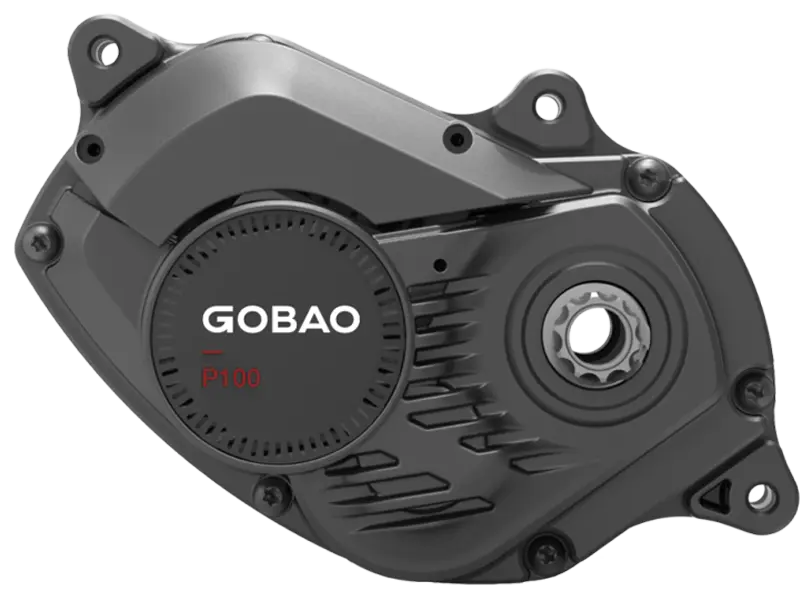
Gobao P100
A powerful challenger from China, increasingly found in OEM bikes (e.g., Hepha). The P100 scores with plenty of power and a well-rounded overall package. With up to 100 Nm, it pushes brutally but often feels less "bio-bike-like" in modulation than Bosch or Brose. The bright color displays are also successful, and a quite fast charger as standard equipment is a positive. A workhorse for riders seeking maximum support and placing less value on brand prestige.
Battery System & Chargers
🔋 Battery System
| Model | Capacity | Weight | Energy Density | Dimensions | Mounting |
|---|---|---|---|---|---|
| BT-800B | 804 Wh | 4 kg | 201 Wh/kg | 367 x 94 x 68 | Internal |
| BT-700B | 708 Wh | 3.8 kg | 186 Wh/kg | 367 x 94 x 68 | Internal |
| BT-600D | 600 Wh | 2.9 kg | 207 Wh/kg | 420 x 73 x 59 | Internal |
🔌 Chargers
| Model | Current | Dimensions |
|---|---|---|
| Fast Charger | 6 A | 182 x 83 x 46 |
Power Characteristics
Shows how much power the motor delivers for a given rider input. The value shown is pure motor power, adjusted for input and drivetrain losses.
Input vs. Output: Gobao P100
Little rider power? No problem for the Gobao P100: In the range under 100 watts, only the Shimano EP801 and the Avinox M1 are stronger here. Furthermore, the Gobao reaches its considerable maximum output of over 730 watts at just around 125 watts of rider power. Of course, with such power delivery, the rule always applies: Naturalness falls by the wayside a bit. However, you can also fall back on the other support levels.
Power vs. Torque: Gobao P100
🧮Power (solid, left axis) and the derived torque (dotted, right axis) across the cadence range. Torque peaks at low cadence and drops as rpm rises — even when power output stays constant.
Shaded: range in which the curve was converted from an older 130-watt measurement and is only an estimate.
Unterstützungsstufen
Comparison of different assistance modes (e.g. Eco, Trail, Turbo).
Profile: Gobao P100
The three available assist modes are linear modes with a fixed assistance factor. They are well differentiated, even though there is a somewhat larger gap between Turbo and Tour mode. If you like, you can also adjust their characteristics to your own preferences via the app.
Cadence Behavior
Shows the optimal RPM range.
Power vs. Cadence (Relative (%))
Converted curves: Gobao P100 were still measured using our previous protocol with 130 watts of rider power. To make them comparable with the other motors, we converted their curves to today’s protocol with 30 Nm of rider torque. Dashed sections mark ranges where the motor had not yet reached its power limit in the old measurement – the values there are estimates.
Power stability across cadence is solid with the Gobao P100, but not outstanding: We see usual power delivery in the range up to 50 rpm, after which the motor adds significantly and is one of the most powerful motors in this specific scenario. From a cadence of 80 rpm, however, the output power drops somewhat before the power loss becomes stronger from 120 rpm.
Thermal Performance
Shows power output performance over 15/20 minutes under constant full load.
20 min
The Gobao shows absolutely no weakness in thermal stability. Despite high power, "only" 36 V voltage, and under 3 kg motor weight, it loses no power over 20 minutes of full load. Strong! Also remarkable: The motor housing doesn't even get 80°C hot. Gobao seems to have constructed a very efficient interior for the motor here.